Project · 2026 · Open source · inference
DGX Spark stacks
Two open recipes for one NVIDIA DGX Spark: a full voice-and-vision AI stack co-resident in 83 GB, and a ~180B model running on a single GB10.
- Role
- Built and open-sourced both stacks, with the measurements, the scripts and the failures written down.
- Hardware
- One DGX Spark (GB10, 128 GB unified)
- Serving
- SGLang · vLLM · NVFP4
- Repos
- 2, on GitHub
27B + vision + ASR + TTS + 3B, co-resident
83 GB
tok/s at 8 concurrent, whole stack resident
140
Qwen3.8-Flash-Next on one GB10, 79.42 GiB resident
~180B
documented multimodal inference of that model on one GB10
1st
01 · What it is
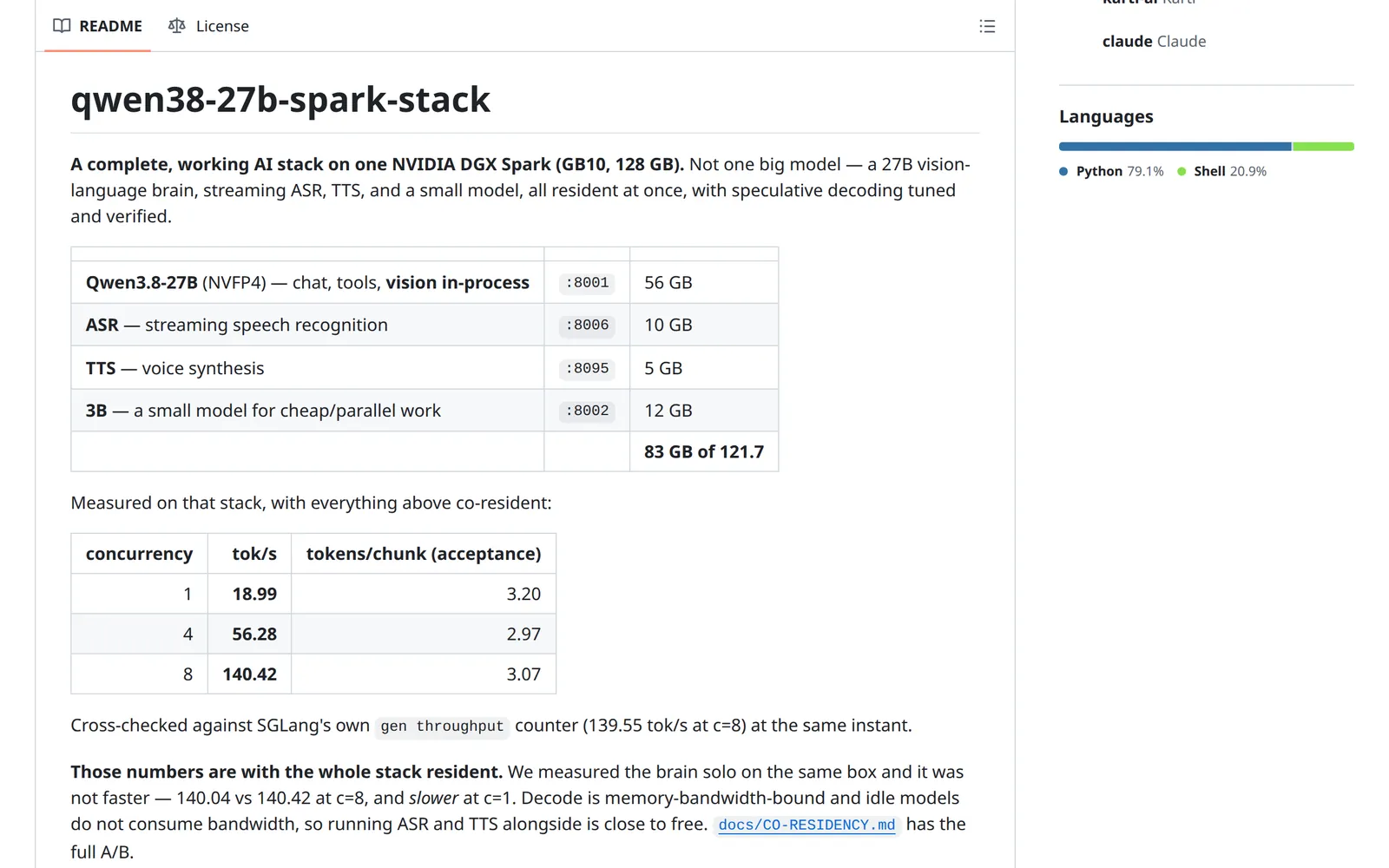
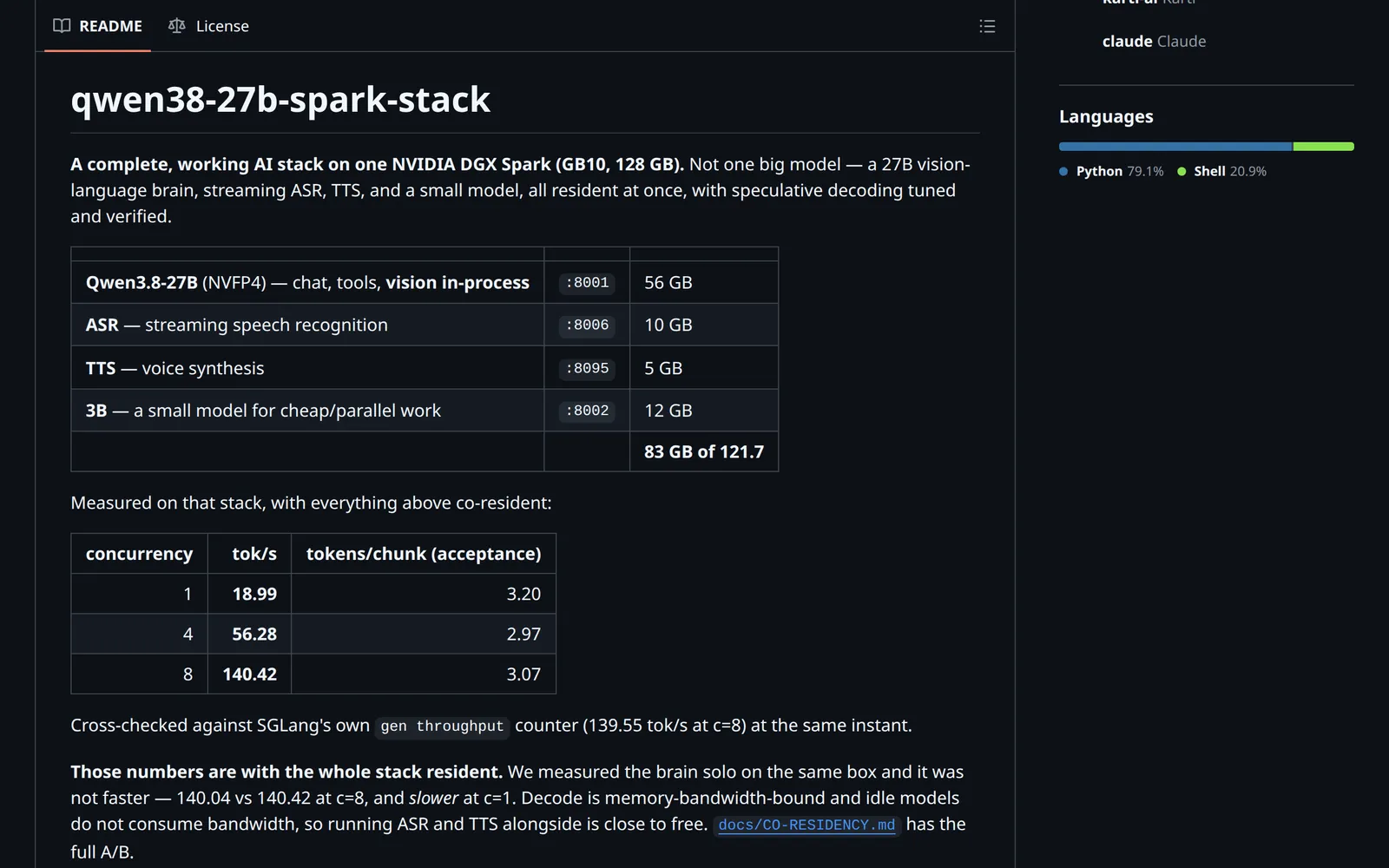
A full AI stack on one DGX Spark: Qwen3.8-27B (NVFP4) with in-process vision, streaming ASR, TTS and a 3B model, co-resident in 83 GB. Not one big model: a 27B vision-language model, streaming speech recognition, speech synthesis and a small model, all resident at once.
~180B Qwen3.8-Flash-Next on a single GB10, its 44 GB n-gram table paged from NVMe. Native vision, 262k context. The model's n-gram table alone is about the size of the memory left over, so it lives on NVMe and is served through the page cache.
02 · How it works
- 01
Budget the box
Qwen3.8-27B in NVFP4 takes 56 GB, ASR 10, TTS 5 and the 3B 12: 83 GB of 121.7. The 27B is a native vision-language model and SGLang serves its vision tower in-process, so a separate 4B vision model came out and gave 14 GB back.
- 02
Co-residency is close to free
Decode is memory-bandwidth-bound and idle models don't consume bandwidth: the 27B alone measured 140.04 tok/s at 8 concurrent, against 140.42 with the whole stack resident. SGLang's own throughput counter read 139.55 at the same instant.
- 03
Page the table, not the model
A token only touches 16 rows of 160 bytes in Flash-Next's ~44 GiB n-gram table, so the table is read from NVMe. Major page faults per token fall about 4.4× from 1 to 48 concurrent streams, because batched tokens share rows.
- 04
Write down the silent failures
A drafter trained for the FP8 target ran against the NVFP4 one at a third of the speed (6.0 vs 18.99 tok/s single-stream) with nothing erroring. A benchmark counting stream chunks instead of tokens under-reported throughput 3.08×. Corrupt weight shards of the right size load cleanly and produce fluent nonsense, so the recipe verifies every shard's checksum.
Known limits
Flash-Next's first throughput numbers were undercounts from the same chunk-counting bug, and they are being remeasured. The recipe documents that the model runs and vision works; it doesn't yet claim a speed.
03 · Stack and links
- vLLM
- SGLang
- NVFP4
- Speculative decoding
- GB10
- qwen38-27b-spark-stackgithub.com/karti-ai/qwen38-27b-spark-stack (opens in a new tab)
- qwen38-flash-next-sparkgithub.com/karti-ai/qwen38-flash-next-spark (opens in a new tab)
- 27B recipe on models.karti.aimodels.karti.ai/recipes/qwen3.8-27b (opens in a new tab)
- Flash-Next recipemodels.karti.ai/recipes/qwen3.8-flash-next (opens in a new tab)
- More recipes at lumbridgecorp.com/recipeslumbridgecorp.com/recipes (opens in a new tab)
- Karti's models in the AI Stackkarti.ai/ai-stack?tag=ours